 Bukovel Tours
Home › Guides › Who Are the Hutsuls of the Ukrainian Carpathians?
Who Are the Hutsuls of the Ukrainian Carpathians?
The Hutsuls are not a vanished mountain tribe. They are an East Slavic ethnic group of western Ukraine and northern Romania, with over 100 villages by the mid-19th century. This guide explains who the Hutsuls are, what the name means and where to meet their culture near Bukovel.
Quick answer Quick answer
The Hutsuls are an East Slavic ethnic group of western Ukraine and northern Romania, and by the mid-19th century they had over 100 villages. Vorokhta, their village at the Hoverla trailhead, is 89 km from Ivano-Frankivsk, and Bukovel sits between the Gorgany and Chornohora ranges nearby.
Key takeaways
- Vorokhta, the Hoverla trailhead, keeps Hutsul traditions and old wooden churches: see how to climb Hoverla.
- Yaremche has a museum of ethnography and the 4 km Dovbush Trail: read Yaremche.
- The wider mountain region is in the Carpathian Mountains of Ukraine.
- Sleep in the mountains, not on the plain: compare where to stay in Bukovel.
Are Hutsuls Ukrainian?
Yes, they are an East Slavic ethnic group of western Ukraine, and the regional council counts them as one of five ethnographic groups of the Ivano-Frankivsk region.
The common belief is that the Hutsuls are a separate mountain tribe with their own country. They are not, though their history has odd turns.
Part of Ukraine, With a Distinct Culture
Wikipedia describes the Hutsuls as an East Slavic ethnic group living in western Ukraine and northern Romania. The regional council lists them as one of five ethnographic groups of the Ivano-Frankivsk region. Each group has its own language, music, architecture and rituals, and international Hutsul folk festivals are held every year.
The confusion comes from 1919, when the region declared itself an independent country, the Hutsul Republic. It was soon incorporated into Czechoslovakia. The region only joined Ukraine, as part of the Soviet republic, in 1945.
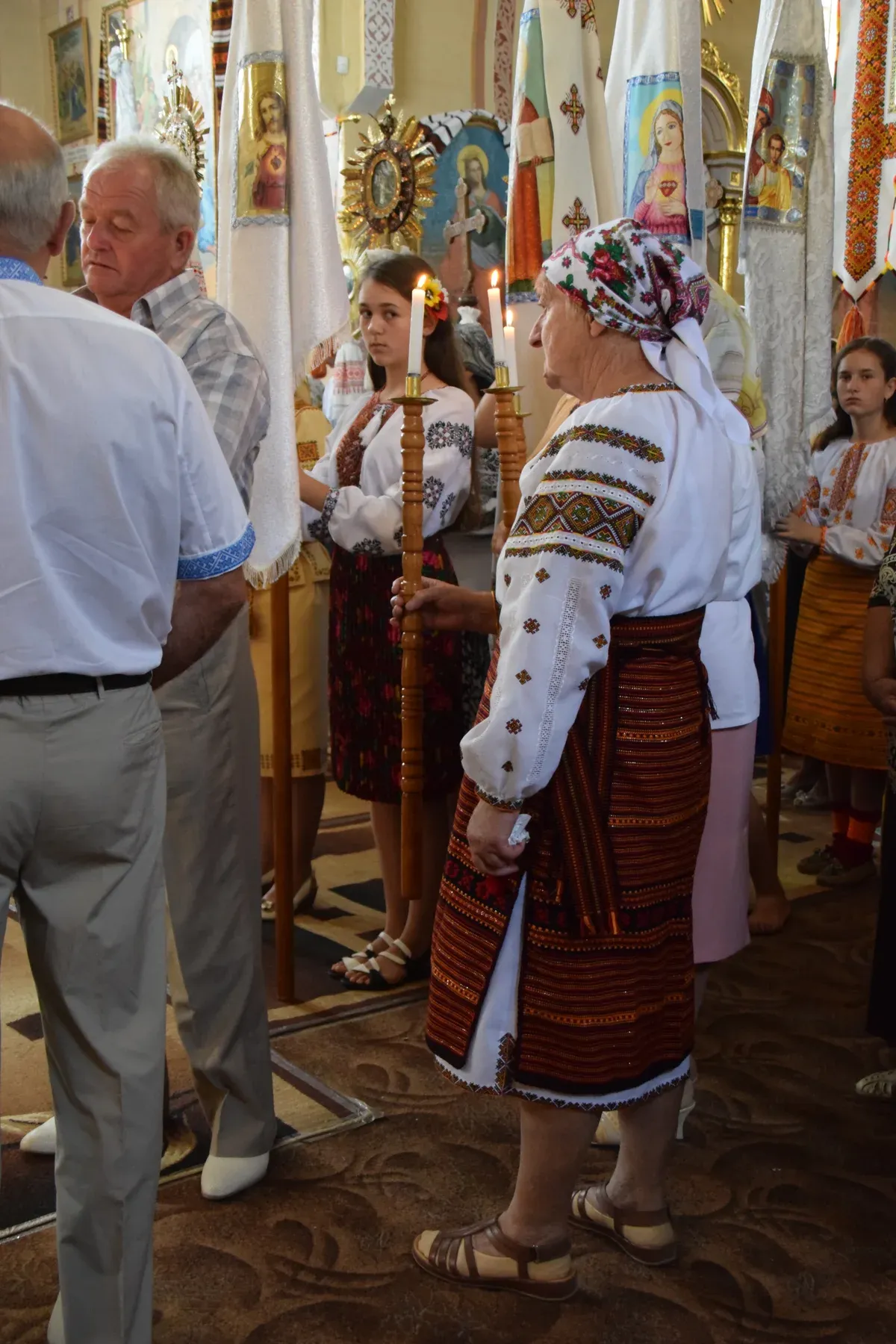
Traditional Hutsul dress at a church service. Photo: Lantuszka, CC BY-SA 3.0, via Wikimedia Commons
What Religion Do Hutsuls Follow?
They are predominantly Ukrainian Greek Catholic or Eastern Orthodox.
Religion shows most clearly in wood, in the old village churches.
Wooden Churches
Notable wooden churches stand in Kryvorivnia, Vorokhta and Yasinia. The Vorokhta council says Vorokhta and neighbouring Tatariv preserve Hutsul traditions and old wooden churches. Tatariv has the wooden St Dmytro church of 1856, and the village lies at 650-750 m, about 78 km from Ivano-Frankivsk.
Hutsul timber building even reached the plain. The two tent-roofed towers of the Cathedral of the Holy Resurrection in Ivano-Frankivsk borrow forms from Hutsul wooden architecture.
Source: Vorokhta council.
What Is the Hutsul Dialect?
It is classified among the Southwestern Ukrainian dialects.
The dialect is a form of Ukrainian, and the regional council notes a distinct language for each group.
Language, Music and Dress
The regional council says each ethnographic group has a distinct language, so expect local words even when the grammar is familiar. Music is the more portable part of the culture. The instruments are the trembita (alpenhorn), sopilka, duda, drymba and tsymbaly. Kolomyka music and troisti muzyky are trademarks.
Traditional dress, such as the serdak coat and the sheepskin kozhushyna, is now worn on special occasions, so it is a festival sight more than an everyday one. Hutsul art has three design groups: geometric, floral and zoomorphic.
What Is the Meaning of the Word Hutzul?
It probably comes from the Romanian hotul, meaning brigand, which is the most widely accepted view since the 19th century.
The origin is uncertain, and the name was first attested in 1816.
Two Theories
The Encyclopedia of Ukraine favours Romanian hotul, a brigand. Wikipedia gives the same root, hot, meaning outlaw, and a second derivation from Slavic kochul, a nomad.
If you searched for Hutsuls knives or strops, those results are an online woodcarving tool shop that uses the name. It sells carving knives, leather strops and spoon carving kits,, and it is a shop, not a guide to the people.
Where Is Hutsulshchyna?
It spans Halychyna, Bukovyna and Zakarpattia, so it does not fit inside one Ukrainian region.
Hutsulshchyna is the Hutsul homeland, and Bukovel sits on its edge.
Towns and Parks on the Map
By the mid-19th century there were over 100 Hutsul villages and 10 noble-owned towns. Kosiv is recorded in 1424, Kuty in 1449 and Vyzhnytsia in 1450. The regional administration names Kosiv as the recognised centre of Hutsul art, with an art fair.
Hutsulshchyna National Nature Park lies in Kosiv district. It covers 32,271 ha, was created in 2002 and lists the Hutsul horse centre Hutsulyk. The horse is the Hucul pony, a breed credited to the Hutsuls. Bukovel itself sits in Polianytsia between the Gorgany and Chornohora ranges.
Sources: Ivano-Frankivsk regional administration, Bukovel resort.
Were the Hutsuls Only Shepherds and Rebels?
No. Forestry, cattle and sheep breeding were the traditional economy, and rebel bands called opryshoks were one chapter, from the mid-16th century to the 1870s.
The rebel image is real, but it is one chapter of the story.
Work and Legend
The traditional economy was forestry, cattle and sheep. The opryshoks, bands of rebels, operated freely through the region from the mid-16th century to the 1870s. The best known is Oleksa Dovbush. In 1740 the Ivano-Frankivsk town hall hosted the trial of the opryshok Fedir Paleichuk and other comrades of Dovbush.
Near Yaremche the Dovbush Trail is an easy 4 km walk of about 3 hours on the right bank of the Prut, overlooking the Prut canyon. It starts near the Dovbush Stone, about 2.5 km from Yaremche station. One stop is Dovbush's stone storehouse, where legend hides a treasure visible on Ivan Kupala night. More on the town in Yaremche.
Which Hutsul Crafts and Foods Are Officially Protected?
Kosiv painted ceramics were inscribed on the UNESCO list in 2019, and Ukraine's national list adds the pysanka, bryndza, cheese sculpture and wood carving.
Crafts are where Hutsul culture turns into things a traveller can buy or taste.
Ceramics, Carving and Cheese
Kosiv painted ceramics entered UNESCO's Representative List of the Intangible Cultural Heritage of Humanity in 2019. Makers shape local grey clay mixed with creamy white clay, scratch a contour drawing before firing, then paint with green and yellow metal oxides. Designs show Hutsul history, folklore, beliefs, plants and animals. UNESCO says the ceramics emerged in the 18th century and peaked in the mid-19th.
Ukraine's national list also includes the Hutsul pysanka tradition around Kosmach and Verkhovyna, koliada and plesy, bryndza, bodnarka, cheese sculpture and the brass traditions of Hutsulshchyna. Hutsul wood carving joined it by order of 12 July 2023. Its geometric motifs are cut at 45-60 degrees and named after mountain life, such as smerichky and besahy. Objects include furniture, roadside crosses, iconostases and wooden pysanky.
| Craft or food | Where it is rooted |
|---|---|
| Kosiv painted ceramics | Kosiv, UNESCO 2019 |
| Pysanka | Kosmach and Verkhovyna |
| Bryndza and cheese sculpture | National list entries |
| Wood carving | National list, 2023 |
| Brass | Hutsulshchyna |
Sources: Ministry of Culture of Ukraine, Cabinet of Ministers.
Where Can a Traveller Meet Hutsul Culture Near Bukovel?
Vorokhta, Tatariv and Yaremche are closest, and Kosiv and Kolomyia hold the big museums.
Check is Bukovel open before you plan any of this, because the UK advises against all but essential travel to the region.
Museums and Villages
Museum hours below run Tuesday to Sunday 10:00-18:00 and every museum is closed on Monday. Vorokhta stands at 850 m on the Prut, 27 km from Yaremche. UN Tourism named it one of the Best Tourism Villages in 2024, and cites its stone viaducts, old wooden churches and early ski racing.
Tatariv, 78 km from Ivano-Frankivsk, adds Zhenets Huk waterfall of about 15 m. Sheshory hosts a three-day international folk music and art festival every summer.
| Place | What it shows | Address |
|---|---|---|
| Yaremche Museum of Ethnography and Ecology | Carpathian life and nature | 269 Svobody St |
| Kolomyia Museum of Hutsul and Pokuttia Folk Art | Hutsul folk art | 25 Teatralna St |
| Kolomyia Pysanka Museum | Over 12,000 pysanky | 43/b Chornovola Ave |
| Kosiv Museum of Folk Art and Life | Hutsul region life | 55 Nezalezhnosti St |
Combine With the Mountains
Vorokhta is also the start of the Hoverla trail, so one day can hold a village and a summit: see Hoverla. For a base near the slopes, the Bukovel ski resort homepage has the status and the hotel options.
Sources: Vorokhta council, Ivano-Frankivsk regional administration.
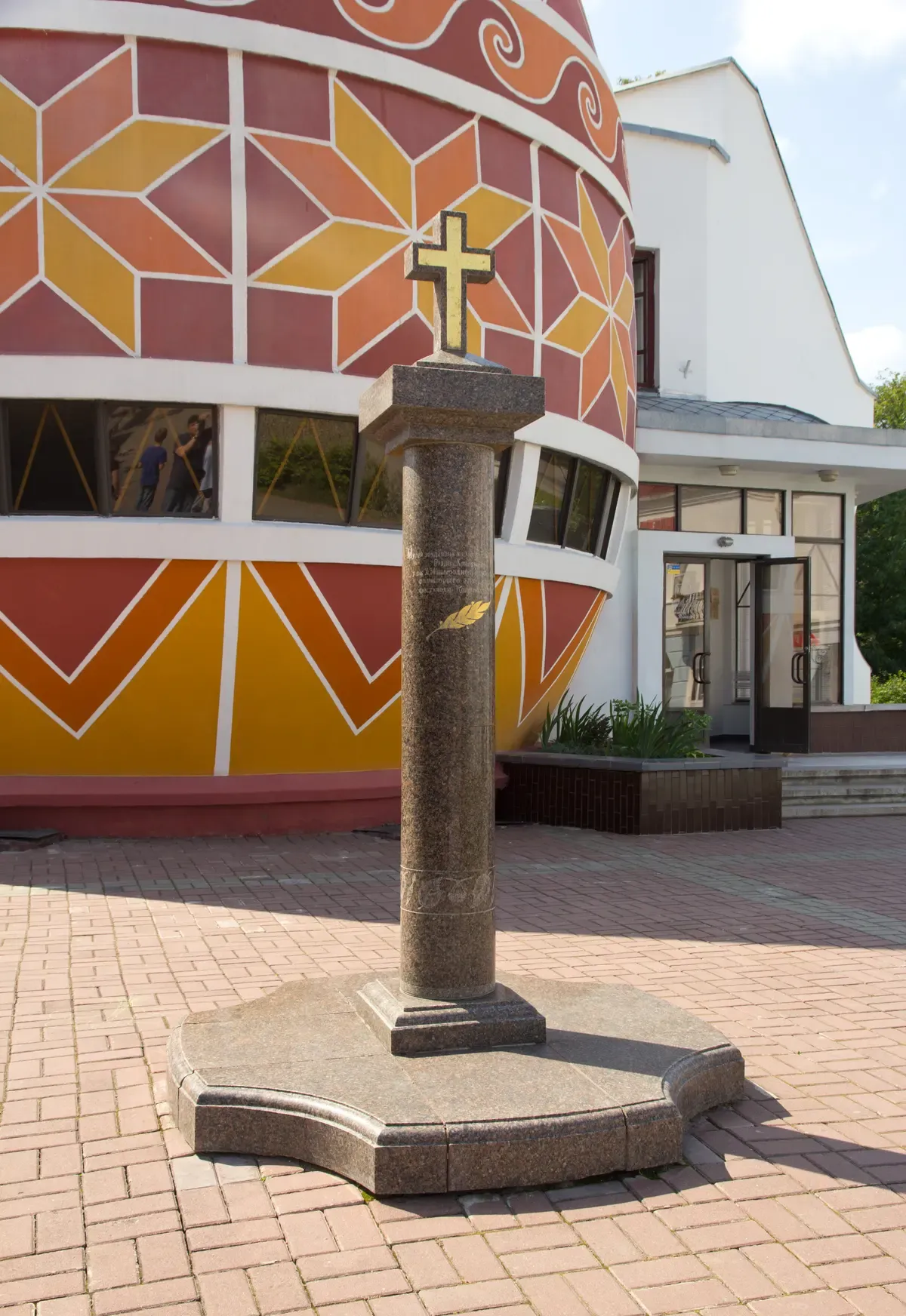
The Pysanka Museum in Kolomyia. Photo: Dmytro Petishkin, CC BY 4.0, via Wikimedia Commons
Hutsuls FAQ
Are Hutsuls Ukrainian?
Yes. They are an East Slavic ethnic group of western Ukraine and the region joined Ukraine in 1945, and the wider region is in the Carpathian Mountains of Ukraine guide.
What religion do Hutsuls follow?
Predominantly Ukrainian Greek Catholic or Eastern Orthodox, and Vorokhta and Tatariv keep old wooden churches near the Hoverla trailhead.
What is the Hutsul dialect?
It is classified among the Southwestern Ukrainian dialects, and you will hear it in villages around Yaremche.
What is the meaning of the word Hutzul?
Most likely the Romanian hotul, a brigand, first attested in 1816. The Bukovel ski resort lies on the edge of the Hutsul region.
Is there a Hutsul festival?
Sheshory hosts a three-day international folk music and art festival every summer, and international Hutsul folk festivals are held every year. A base in the mountains is covered in where to stay in Bukovel.
Do Hutsuls live outside Ukraine?
Yes, in northern Romania as well. Inside Ukraine, the nearest big slopes are compared in ski resorts in Ukraine.
More Guides
- Christmas in Ukraine 2026: How Is It Celebrated and Where to Spend It?
Christmas in Ukraine 2026: the 12 dishes, carols, and the 25 December to 7 January ski season at Bukovel. Plan your stay.
- How Do You Climb Hoverla, Ukraine's Highest Mountain?
How to climb Hoverla (2,061 m): blue and green paths, 3-3.5 h up, park rules and season. Plan your 2027 hike with this guide.
- What Is There to Do in Yaremche Near Bukovel?
What to do in Yaremche: Probiy waterfall, the 4 km Dovbush Trail and Dora. Plan a half day on your 2027 Carpathian trip.